
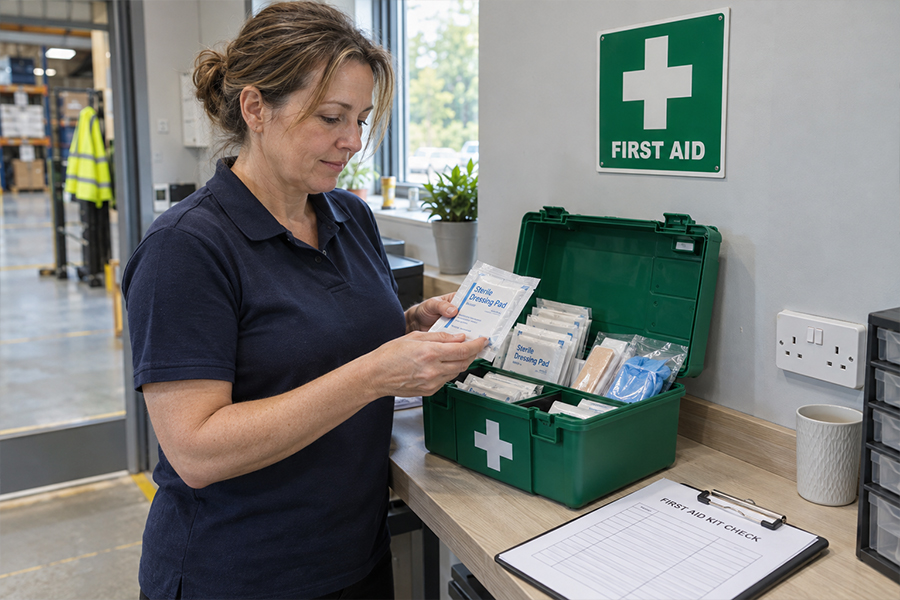
Workplace first aid kit checklist: Free inspection log

Under the Health and Safety (First-Aid) Regulations 1981, employers must provide adequate and appropriate equipment, facilities and personnel so employees can receive immediate help after injury or sudden illness. Therefore, this article follows current HSE first-aid guidance for Great Britain. Northern Ireland uses separate 1982 regulations, although HSENI has adopted HSE guidance to help employers assess their provision.
Download the free printable log below. It gives you a kit register, an inspection record and a replenishment action sheet, so you can adapt one practical system to your workplace.
How should you use a workplace first aid kit checklist?
Start by giving every kit a unique reference, such as OFFICE-01 or VAN-03. Next, record its exact location, responsible person and chosen inspection interval. This simple register matters when a site has several floors, vehicles or temporary work areas.
HSE says employers should examine first-aid containers frequently and restock them soon after use. Nevertheless, HSE does not prescribe one universal weekly or monthly interval. Consequently, choose a schedule that reflects likely use, workplace hazards, environmental conditions and the consequences of a shortage. Also, arrange an extra check after anyone opens a kit or reports missing stock.
During each review, compare the actual stock with your approved inventory. In addition, check packaging, seals, cleanliness, damage and expiry dates. Record any shortfall straight away, assign an owner and confirm completion rather than relying on memory.
Who should own the checks?
An appointed person can take charge of first-aid arrangements, including equipment, facilities and contact with the emergency services. However, an appointed person does not automatically become a trained first-aider. Therefore, define both roles clearly and make sure suitable cover remains available whenever people work.
For example, the appointed person might run the kit check while a trained first-aider advises on specialist items. On a shared site, employers can coordinate their arrangements; nevertheless, each employer should understand and document the agreed responsibilities.
What belongs in a workplace first aid kit?
Your first-aid needs assessment should drive the answer. In particular, consider your work activities, hazards, workforce size, shift pattern, accident history, site layout and distance from emergency medical services. Also, include travelling, remote and lone workers where relevant.
For a lower-risk workplace, HSE suggests a basic range rather than one compulsory shopping list. Depending on your assessment, the kit may include:
- a general first-aid guidance leaflet;
- individually wrapped sterile plasters in assorted sizes;
- sterile eye pads and individually wrapped triangular bandages;
- large and medium sterile, unmedicated wound dressings;
- safety pins and disposable gloves.
If you buy a ready-made kit, HSE advises employers to look for British Standard BS 8599. However, the law does not require a kit to meet that standard. Above all, make sure its contents match the needs assessment instead of assuming that a label or kit size settles the question.
Moreover, HSE recommends that employers do not keep tablets and medicines in the first-aid container. Store only items useful for first aid, and protect the container from dust and damp. If a sterile product shows no expiry date, ask its manufacturer how long you may keep it; meanwhile, check every undated non-sterile item remains fit for purpose.
What might a higher-risk site add?
A higher-risk activity may justify extra materials, equipment, trained personnel or more than one kit. For example, HSE lists foil blankets, haemostatic dressings, tourniquets, wound-packing materials, disposable aprons and moist wipes as possible additions when the assessment identifies a need. Specialist equipment also requires suitable training and secure, practical storage.
Likewise, provide sterile water or normal saline for wound and eye irrigation when mains tap water does not remain readily available. Then follow the manufacturer’s instructions, discard opened containers and never use them beyond their expiry date. Do not add specialist supplies simply because a template includes a blank row.
What should each kit inspection record?
A useful workplace first aid kit checklist shows what the checker found and what happened next. Therefore, keep the inspection log concise but traceable. The following sequence works for an office, workshop, warehouse or vehicle kit:
- Confirm the kit identity. Record the kit reference, location, date, time and inspector.
- Check access and identification. Make sure people can reach the kit and recognise its white cross on a green background.
- Compare stock. Count items against the approved site inventory and minimum levels.
- Examine condition. Check seals, packaging, cleanliness, damage and the earliest relevant expiry dates.
- Control shortages. Remove unsuitable items safely, record what needs replacement and provide an interim arrangement where necessary.
- Close the action. Name an owner and due date; afterwards, record who verified the replenishment and when.
Do not wait for the next scheduled check after someone uses supplies. Instead, create a simple route for first-aiders and employees to report use immediately. As a result, the appointed person can restock the kit before another incident occurs.
When should you review the whole arrangement?

HSE updated its L74 guidance in 2024 to emphasise mental health within the needs assessment and to expand guidance on life-threatening bleeding. Consequently, check the current HSE First aid at work guidance instead of relying on an old cabinet list.
How do signs help people find first aid quickly?
Employers must tell employees about the location of first-aid equipment, facilities and personnel. Therefore, combine induction and local procedures with visible information. HSE recommends clear first-aid notices, while its L74 guidance identifies a white cross on a green background for first-aid containers.
A correctly placed E003 first aid symbol can help people spot a cabinet or room. Similarly, a Your First Aiders Are sign can display the current contacts. Keep names and locations up to date, remove obstructions and check visibility from the normal approach route.
However, a sign cannot stock a kit, train a first-aider or control a hazard. Treat signage as one supporting part of the arrangement, and browse the EU Signs Ltd first aid signs only after you have identified the message and location your site needs.
Can the log support ISO 45001 records?
A controlled kit register can support a wider occupational health and safety management system. For example, it can show planned monitoring, assigned responsibility, corrective action and verification. It can also reveal repeated shortages that deserve a deeper review.
Nevertheless, the log does not prove compliance with ISO 45001, and it cannot secure certification. Instead, align the document with your organisation’s own document control, competence, operational planning and improvement processes.
Download the free inspection log
Use the free workplace first aid kit checklist and inspection log to register each kit, define its approved inventory, record checks and close replenishment actions. First, customise the minimum stock and review interval from your needs assessment. Then print one inspection sheet per check or transfer the fields into your controlled digital system.

Download the free workplace first aid kit checklist and inspection log.
This general guide and template do not replace current HSE or HSENI guidance, your risk assessment or competent advice. If you need clear first aid signs for an office, workshop, warehouse, vehicle or construction site, contact EU Signs Ltd in Borehamwood, Hertfordshire. We serve UK mainland customers. We do not charge extra for graphic design of safety signs.
From Our Shop:
Featured From Our Blog:







Recent Comments