
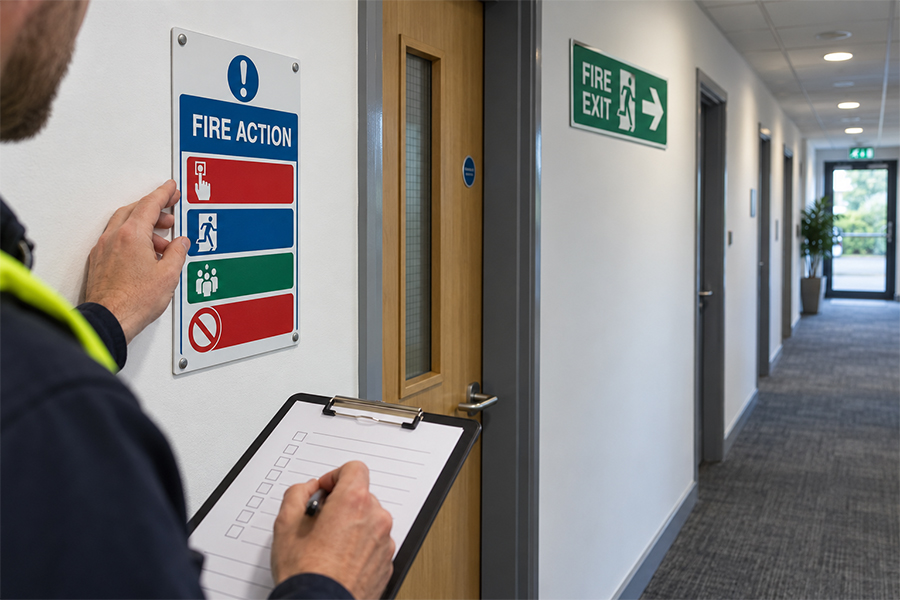
Fire action notice checklist: Free workplace signage review
A fire action notice checklist helps a responsible person check whether workplace instructions still match the building, the emergency plan and the people who use the premises. A notice can look tidy yet give the wrong assembly point, refer to a moved alarm or hide behind new equipment. Therefore, review the message and its surroundings together.
This practical guide focuses on England and Wales, where the Regulatory Reform (Fire Safety) Order 2005 provides the main legal framework for most non-domestic premises. Scotland and Northern Ireland follow separate arrangements. The GOV.UK workplace fire-safety guidance says the responsible person must assess risk, maintain suitable precautions, plan for emergencies and give staff information, instruction and training.
Use the free printable review sheet below to record what you find. It does not replace a fire risk assessment, a competent fire-safety review, alarm maintenance or evacuation training. Instead, it gives your team a clear way to check the information that people may rely on during an emergency.

Review site-specific fire instructions after changes to rooms, routes, contacts or assembly arrangements
What should a fire action notice checklist cover?
Begin with the document or procedure that controls your evacuation arrangements. Then compare every displayed notice with that approved information. A useful review covers the message, location, condition, visibility and link to staff instruction. It also records the person who checked it and the action needed when something no longer fits.
For a small office or shop, the emergency plan may consist of little more than a fire action notice. However, larger, shared or complex premises normally need a fuller plan that coordinates occupiers, visitors, contractors, nominated staff, alarm arrangements and assistance for people who may need help. The Home Office’s offices and shops guidance makes this distinction clear.
Who owns the workplace fire action notice?
Name the responsible person, deputy or fire-safety coordinator who owns the review. In shared premises, ask the other responsible persons to agree the building-wide arrangements. In addition, tell reception, supervisors, cleaners, contractors and visitors how to find the current instructions. A named owner prevents a damaged notice from remaining on the wall because everyone assumed somebody else would replace it.
Record the premises, floor or area, notice reference, review date and source document. Next, record whether the reviewer found the notice correct, readable and suitable for the people who need to understand it. Keep personal information out of a public notice; list roles or contact points unless your approved plan requires named individuals.
Which fire safety messages should appear?
Your fire safety notice checklist should test the actions people must take, not just the presence of a green or red sign. The exact wording depends on your approved plan, the alarm system, the premises and the risk assessment. Nevertheless, many workplace notices need to explain the following:
- how to raise the alarm after discovering a fire;
- what to do when the alarm sounds;
- which escape routes or final exits people should use;
- where people should assemble and who will account for them;
- that nobody should re-enter until an authorised person gives permission;
- how to contact the fire and rescue service, using the procedure approved for the site;
- who holds key fire-safety roles and where staff can read the fuller emergency plan.
Do not copy a generic notice without checking each instruction. For example, a sign that says “operate the nearest alarm” becomes misleading if the call point moved during a refurbishment. Likewise, an assembly point sign becomes unreliable when a neighbouring contractor blocks the area or the site changes its traffic plan.
How do you adapt an emergency evacuation notice?
Use a controlled master wording and record its revision. Mark the assembly point, emergency contact route, alarm method and any special arrangements in the same way across the site. If staff speak different languages or visitors may not read English confidently, explain the procedure in forms they can understand. Also, include arrangements for people with disabilities, temporary workers and anyone unfamiliar with the premises.
Where the risk assessment identifies fire hazards, check related warnings and instructions too. A fire door that should remain shut may need a suitable notice, while a locked fire door or a hazardous store may need different wording. The review should confirm that each notice supports the actual control and does not create conflicting instructions.
Where should emergency evacuation notices go?
Place each notice where the intended reader can see and understand it before an emergency occurs. The Home Office guidance says signs and notices should be easy to see and understand, and it lists fire action notices among the notices that may be necessary. Therefore, choose positions that people naturally pass, such as reception areas, alarm call points, staff noticeboards, entrances and shared circulation spaces.
Use this short walkthrough during your fire safety signage inspection:
- Start at the entrance. Check that a visitor can find the basic instructions without knowing the building.
- Follow the alarm route. Confirm that the notice sits near the relevant call point or alarm information.
- Walk every escape route. Check that directional signs lead towards a suitable exit and that the next sign remains visible.
- Check equipment points. Confirm that fire extinguishers, fire telephones or other facilities have the notices identified by the risk assessment.
- Check the assembly area. Make sure the assembly point sign remains visible, accessible and consistent with the emergency plan.
- Record obstructions. Note furniture, stored materials, temporary hoardings, poor lighting or dirty surfaces that hide the message.
Never use an arrow by itself to direct people. Where a route is not obvious, use a complete escape-route sign with the correct directional arrow and position signs so that a person escaping can see the next instruction. If the risk assessment requires photoluminescent or illuminated information, check that the chosen product and lighting arrangement suit the environment.
How do you review fire exit signs and related notices?
Separate the message review from the physical condition review. First, check the wording against the current plan. Then inspect fading, peeling, cracks, dirt, glare, poor contrast and damage. Next, look for changes in doors, partitions, machinery, racking or lighting that alter what a person can see from the approach route. A sign remains useful only when people can recognise it quickly in the conditions that the risk assessment considered.
Keep the fire action notice checklist with the inspection record and link each correction to the relevant room, route or notice reference. That simple trail helps a manager prove what changed, who checked the replacement and whether the information still matches the emergency plan.
Fire exit signs should communicate clear, unambiguous information. Similarly, notices for fire equipment should identify the correct item and remain visible. Do not move an exit sign simply to improve appearance; check the route, viewing direction and building layout first. If work temporarily changes the route, provide controlled temporary information and remove it when the approved arrangement returns.
When should you review the fire safety signage?
The law and guidance do not give every workplace one universal monthly or weekly sign-check interval. Instead, set a proportionate interval through your fire-safety management arrangements and review sooner after a change. Trigger an additional check after refurbishment, a change of tenant, new machinery, a blocked route, an alarm alteration, a drill finding, an incident or a report that people could not find the exit.
Close each finding with an owner and date. If a sign gives incorrect instructions, correct the information promptly and consider interim measures while you arrange a replacement. Finally, verify that the new sign matches the approved plan, sits in the intended position and remains visible from the normal approach.

Check the notice, route, lighting and surrounding obstruction together.
Can a fire signage checklist support ISO 45001?
A controlled review record can support an ISO 45001 emergency preparedness process by showing planned checks, assigned responsibilities, worker feedback, corrective actions and verification. It can also help you identify repeated problems, such as notices that disappear after layout changes or assembly points that no longer suit the site.
However, the record does not prove conformity and a sign cannot replace the wider management system. Link the completed sheet to your fire risk assessment, emergency plan, training record, drill review and corrective-action process. This approach gives an auditor evidence of how your organisation controls information while keeping the fire-safety decision with the responsible person and competent advisers.
Keep the controlled master separate from completed inspection sheets. Record revision dates, approval, access and retention under your document-control process. When you change the wording, communicate the change to workers and check that old copies no longer remain in use.
Download the free fire action notice review checklist
Download the free fire action notice checklist to review wording, placement, visibility, escape-route information, assembly points and follow-up actions. First, adapt the fields to your premises and approved emergency plan. Then use one sheet for each area or inspection round, and retain completed records with your fire-safety evidence.

Download the free fire safety signage review sheet.
EU Signs Ltd designs and supplies fire action notices, fire exit signs, assembly point signs and custom safety signage for UK workplaces. Browse the fire action signs range or view fire exit signs after confirming the messages and locations your assessment requires. For a site-specific enquiry, contact EU Signs Ltd in Borehamwood, Hertfordshire or email sales@eusigns.co.uk. We do not charge extra for graphic design of safety signs.
From Our Blog:
From Our Shop:
- First Aid Action Notice
- Private Property Notice Board
- Your First Aiders Are Located Sign
- Your First Aiders Are Sign






Recent Comments