
RIDDOR reporting checklist: Free incident record pack

Clear responsibilities help teams move from an incident record to practical action.
A RIDDOR reporting checklist helps you organise the facts after a workplace incident. However, an accident book entry does not replace a report to the enforcing authority. Your team needs to recognise the difference, identify the right reporting route and follow up on the causes.
HSE opened its consultation on changes to RIDDOR on 7 April 2026 and closed it on 7 July 2026. The proposals make this a useful time to review your process. Nevertheless, a consultation does not itself change the law. This guide follows HSE’s current reporting guidance, which we checked on 23 September 2026.
This article covers England, Scotland and Wales. By contrast, Northern Ireland follows separate rules; consult HSENI’s incident reporting guidance for workplaces there. Download our free pack below to record decisions and track corrective actions.
How does a RIDDOR reporting checklist help?
RIDDOR stands for the Reporting of Injuries, Diseases and Dangerous Occurrences Regulations. First, distinguish your internal reporting procedure from the legal reporting test. Encourage workers to raise accidents, concerns and near misses promptly. Then ask the responsible person to assess whether the event meets a reportable category.
Above all, use the checklist as a prompt, not an automatic decision tool. For example, the location alone does not establish a work connection. Consider the work activity, equipment and condition of the premises, using HSE’s key definitions. Meanwhile, arrange urgent assistance and control any continuing danger before completing paperwork.
Who should make the report?
HSE assigns reporting duties to the responsible person, such as the employer, certain self-employed people or the person controlling the premises. Therefore, name a lead and a deputy in your procedure. However, an internal job title does not transfer the legal duty.
For agency workers and contractors, clarify the working relationship and relevant responsibilities. Also, tell employees how to contact the reporting lead; do not assume every injured worker should submit a RIDDOR report personally.
Which events need a closer look?
Start with HSE’s reportable incident categories. In particular, check:
- Work-related deaths and specified injuries to workers.
- Injuries that prevent normal work for more than seven consecutive days.
- Qualifying injuries to people who are not at work.
- Occupational diseases that meet the relevant diagnosis and work-related criteria.
- Dangerous occurrences that match a category in the regulations.
For a non-worker, such as a customer, check whether a work-related accident caused an injury and someone took them directly to hospital for treatment. However, diagnostic tests alone do not count as treatment. Different provisions apply when the accident happens at a hospital, so consult the full guidance.
Similarly, a near miss does not automatically trigger RIDDOR. Nevertheless, some events require reporting even when nobody suffers an injury. Check HSE’s dangerous occurrence definitions and any sector-specific provisions, including relevant gas incidents. Record internal near misses too, so your team can address hazards before someone suffers harm.
How do you count absence and restricted duties?
For the over-seven-day test, exclude the accident day but include weekends and rest days. Also, count incapacity for normal duties, not simply absence from the workplace. Someone who returns on restricted duties may still meet the reporting threshold.
Separately, keep a record when incapacity exceeds three consecutive days. That threshold alone does not require a report, although another reportable category might. Therefore, follow up after the initial entry rather than closing the record immediately.
Which reporting deadlines should you track?
Follow HSE’s reporting timescales for the category you identify. For reportable deaths, specified injuries, qualifying non-worker injuries and dangerous occurrences, notify the enforcing authority without delay. Then ensure it receives the report within ten days. Do not treat ten days as permission to postpone notification.
For over-seven-day injuries, submit the report within 15 days of the accident. For reportable occupational diseases, report as soon as the responsible person receives the diagnosis. Because categories and circumstances differ, escalate uncertainty promptly through competent health and safety advice.
Keep your RIDDOR reporting checklist beside the incident record. Next, enter the applicable deadline, the person handling the report and the next review date. This simple handover helps a deputy continue the process during annual leave or shift changes.
How can you turn an incident into corrective action?
A submission finishes one task, but it does not remove the hazard. Instead, use the following sequence to organise your investigation and follow-up:
- Gather facts. Record the time, location, activity and immediate response. Also, reference witness accounts and relevant photographs securely.
- Record the decision. Identify the reporting category, explain your reasoning and note any unresolved questions. Then set a review date.
- Explore the causes. Look beyond an individual’s actions. For example, check work planning, equipment, supervision and access arrangements.
- Assign improvements. Then give each action an owner and deadline. Prioritise removing or controlling the hazard; signage can support those measures.
- Check effectiveness. Afterwards, ask whether the change actually works. Finally, record evidence, review residual risks and share the relevant lessons.
HSE’s incident investigation workbook offers further guidance. In addition, ISO 45001 connects incident investigation with wider health and safety management and continual improvement. Our action record can support that work; however, a completed form does not prove conformity or guarantee certification.
What evidence should you retain?
Follow HSE’s record-keeping guidance and save your submission reference and report copy. Also, link the internal record to your action log, relevant risk assessment and review evidence. Use a consistent incident reference so colleagues can follow the history.
Likewise, keep personal and medical details secure. For example, share an anonymised lesson at a team briefing instead of displaying an injured person’s details. Agree access and retention arrangements with the person responsible for your records.
Where can clear signs support the process?

Place reporting reminders where staff can find help and understand the next step.
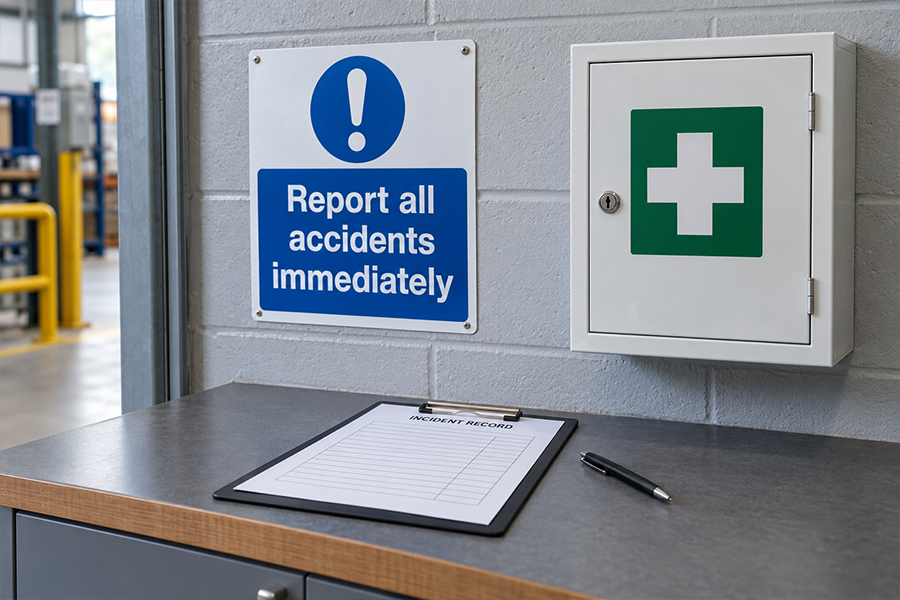
Start with the route employees already use to seek help. A Report All Accidents Immediately sign can reinforce your internal procedure near a supervisor’s office or staff noticeboard. Alongside it, provide the current reporting contact and explain the procedure during induction.
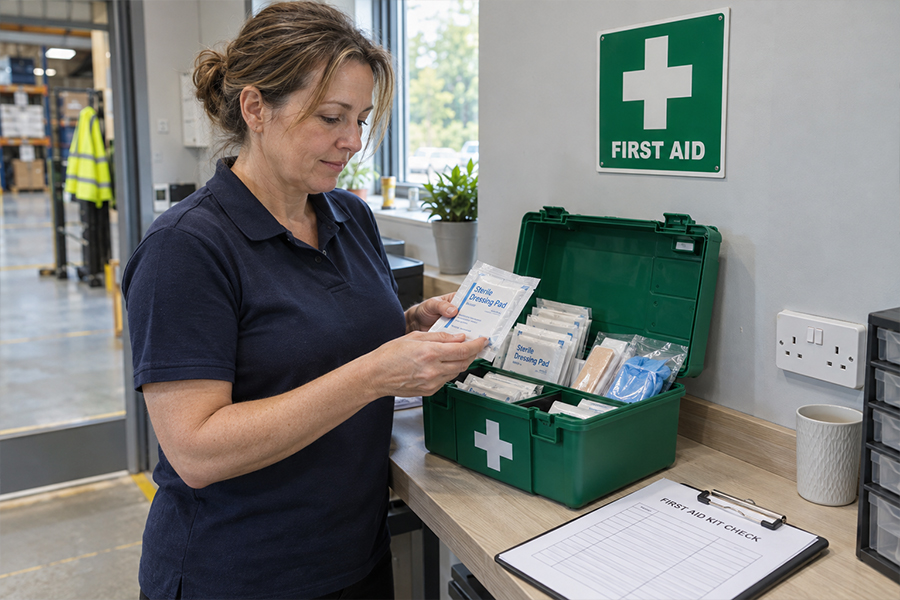
Similarly, a first aid symbol sign can identify the location of first aid equipment. Keep the information visible and review it when layouts or personnel change. However, signs do not replace risk controls, training, suitable first aid arrangements or statutory reporting.
Download your free checklist and record pack
Use our RIDDOR reporting checklist with the incident decision record and corrective-action log. The printable pack provides space for facts, reporting decisions, owners, deadlines and effectiveness checks. First, adapt it to your workplace. Then keep completed copies securely within your incident management system.

Download the free RIDDOR checklist and incident record pack.
This general guide and template support your process; they do not replace current HSE guidance or competent advice. If you need clearer custom workplace reporting signs and forms, contact EU Signs Ltd in Borehamwood, Hertfordshire. We serve UK mainland customers. We do not charge extra for graphic design of safety signs.







Recent Comments